
The word “anxiety” never appears in the King James Bible. But the feeling is everywhere in it.
David cried out from a heart that was overwhelmed. Elijah sat under a tree and wanted to give up. And on the night before the cross, Jesus Himself was in such agony in Gethsemane that His sweat was like great drops of blood. The Bible knows exactly what a worried, restless, fearful heart feels like.
The King James Version simply uses older words for it. When Paul writes “Be careful for nothing,” he means “do not be anxious about anything.” When Jesus says “take no thought for the morrow,” He means “stop worrying about tomorrow.” And Proverbs calls it “heaviness in the heart.”
In 38 years of ministry, I have sat with many people whose minds would not stop racing. Again and again, I have watched God’s Word bring a peace that nothing else could. These 49 verses are arranged in five sections, so you can go straight to what you are facing today.
The verse I hold on to myself is Philippians 4:6. The King James Version puts it this way: “Be careful for nothing; but in every thing by prayer and supplication with thanksgiving let your requests be made known unto God.” Whatever words you know it by, it is an invitation to bring every worry to God.
If you only read three today
- “Be careful for nothing; but in every thing by prayer and supplication with thanksgiving let your requests be made known unto God.” — Philippians 4:6
- “Casting all your care upon him; for he careth for you.” — 1 Peter 5:7
- “Thou wilt keep him in perfect peace, whose mind is stayed on thee: because he trusteth in thee.” — Isaiah 26:3
Bible verses for anxiety: find the right verse for what you are facing
Anxiety shows up in different ways. Start with what you are feeling right now.
If you are worried, start with Philippians 4:6–7; afraid, Isaiah 41:10; sleepless, Psalm 4:8; overwhelmed, Romans 8:26.
How to use these verses when anxiety rises
1. Pause and breathe slowly. Then read one verse, not ten. 2. Read it aloud. Hearing God’s Word in your own voice can quiet a racing mind. 3. Pray it back to God. For example: “Lord, I cast this care on You, because You care for me.” 4. Name the worry. Tell God exactly what you are afraid of. Philippians 4:6 invites you to bring “every thing.” 5. Keep it close. Save the verse as your phone’s lock screen or write it on a card by your bed.
1. When worry won’t let go (10 verses)
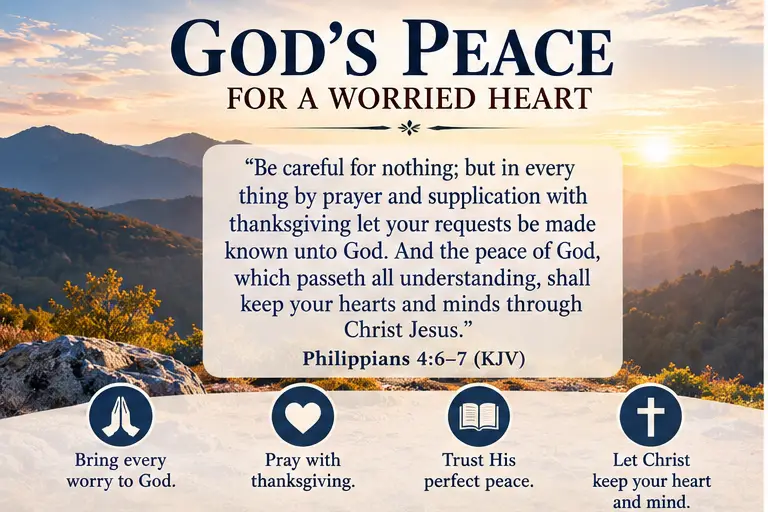
Worry tells you that everything depends on you. These verses invite you to put the weight down.
- Philippians 4:6–7: Trade worry for prayer, and receive God’s peace. “Be careful for nothing; but in every thing by prayer and supplication with thanksgiving let your requests be made known unto God. And the peace of God, which passeth all understanding, shall keep your hearts and minds through Christ Jesus.”
What it means: Paul invites believers to bring specific concerns to God with thanksgiving. The promise of peace does not mean every difficulty disappears; it means God can guard our hearts while we face them.
Put it into practice: Write down three worries, pray about each one, and name one thing for which you can give thanks today.
- 1 Peter 5:7: God cares about what you are carrying. “Casting all your care upon him; for he careth for you.”
What it means: Peter encourages believers to entrust their anxieties to God because His care is personal, not distant.
Put it into practice: Name one burden you have been carrying alone, pray about it, and consider sharing it with a trusted friend or pastor.
- Psalm 55:22: God will hold you up. “Cast thy burden upon the LORD, and he shall sustain thee: he shall never suffer the righteous to be moved.”
What it means: God’s invitation to cast a burden on Him does not require you to pretend the burden is light.
Put it into practice: Write one concern on paper and pray about the support you need to face it.
- Isaiah 26:3: Perfect peace for a mind fixed on God. “Thou wilt keep him in perfect peace, whose mind is stayed on thee: because he trusteth in thee.”
What it means: This promise connects steadfast attention to God with trust; peace grows as we return our thoughts to Him.
Put it into practice: When your mind spirals, pause and repeat this verse slowly.
- Matthew 11:28: Jesus offers rest to the weary. “Come unto me, all ye that labour and are heavy laden, and I will give you rest.”
What it means: Jesus welcomes people exhausted by life’s demands and invites them to come to Him for rest.
Put it into practice: Take five quiet minutes to tell Christ what has left you weary.
- John 14:27: A peace the world cannot give. “Peace I leave with you, my peace I give unto you: not as the world giveth, give I unto you. Let not your heart be troubled, neither let it be afraid.”
What it means: Jesus speaks of a peace different from the temporary reassurance circumstances can provide.
Put it into practice: Before checking another worrying update, pause and pray for a settled heart.
- Proverbs 12:25: A good word lifts a heavy heart. “Heaviness in the heart of man maketh it stoop: but a good word maketh it glad.”
What it means: An anxious heart can feel weighed down, while a kind word can offer genuine encouragement.
Put it into practice: Send a supportive message to someone, or tell a trusted friend what is troubling you.
- Psalm 94:19: God’s comfort in the middle of racing thoughts. “In the multitude of my thoughts within me thy comforts delight my soul.”
What it means: The psalmist acknowledges many troubling thoughts and finds consolation in God’s comfort.
Put it into practice: Write down a recurring thought and answer it with a reminder of God’s care.
- 2 Thessalonians 3:16: Peace always, in every way. “Now the Lord of peace himself give you peace always by all means. The Lord be with you all.”
What it means: Paul prays that the Lord of peace will give peace in every circumstance.
Put it into practice: Pray this blessing over yourself and someone facing a difficult week.
- Colossians 3:15: Let God’s peace rule your heart. “And let the peace of God rule in your hearts, to the which also ye are called in one body; and be ye thankful.”
What it means: God’s peace is meant to guide life within the community of believers, alongside thankfulness.
Put it into practice: Choose a gracious response in one tense conversation and express one specific thanks.
2. When fear takes over (10 verses)
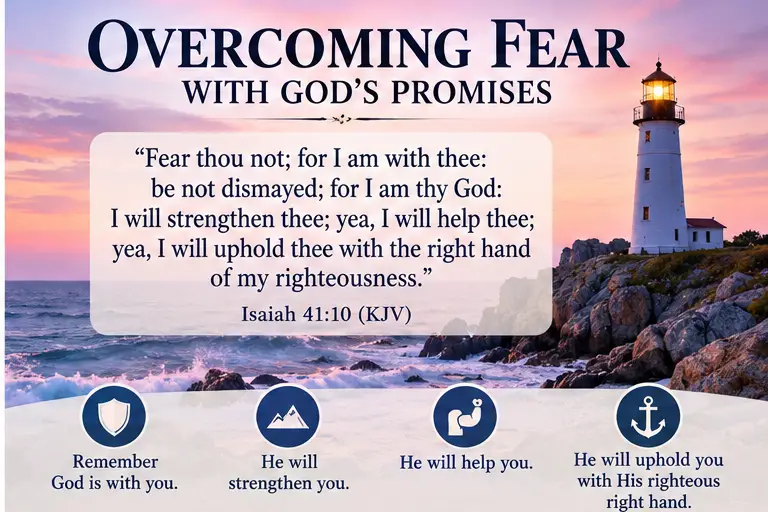
“Fear not” is one of the most repeated commands in Scripture. It is never a scolding. It always comes with a reason: God is with you.
- Isaiah 41:10: God strengthens, helps and holds you up. “Fear thou not; for I am with thee: be not dismayed; for I am thy God: I will strengthen thee; yea, I will help thee; yea, I will uphold thee with the right hand of my righteousness.”
What it means: God’s reassurance includes his presence and help; fear need not be faced in isolation.
Put it into practice: Write down one fear and pray for strength to face the next step.
- 2 Timothy 1:7: Fear does not come from God. “For God hath not given us the spirit of fear; but of power, and of love, and of a sound mind.”
What it means: Paul encourages Timothy toward courage, love, and sound judgment in his calling.
Put it into practice: Choose one wise, loving action instead of allowing fear to make the decision.
- Psalm 56:3: Trust when fear comes. “What time I am afraid, I will trust in thee.”
What it means: The psalmist does not deny fear; he responds to it with trust.
Put it into practice: When you notice fear rising, say a brief prayer of trust.
- Psalm 27:1: With God as your light, whom shall you fear? “The LORD is my light and my salvation; whom shall I fear? the LORD is the strength of my life; of whom shall I be afraid?”
What it means: Calling the Lord light and salvation shifts the focus from threats to God’s sustaining presence.
Put it into practice: Recall one occasion when God helped you through uncertainty.
- Psalm 34:4: God delivers from all fears. “I sought the LORD, and he heard me, and delivered me from all my fears.”
What it means: David remembers seeking the Lord and finding deliverance from fear.
Put it into practice: Tell God plainly what you fear, and ask a trusted person to pray with you.
- 1 John 4:18: God’s love drives out fear. “There is no fear in love; but perfect love casteth out fear: because fear hath torment. He that feareth is not made perfect in love.”
What it means: John is speaking about God’s love and confidence before judgment, not shaming people for symptoms of anxiety.
Put it into practice: Meditate on God’s love without treating fear as a personal failure.
- Isaiah 43:1: You are His, and He knows your name. “Fear not: for I have redeemed thee, I have called thee by thy name; thou art mine.” (excerpt)
What it means: God addresses his redeemed people with assurance of belonging; the excerpt points to that covenant promise.
Put it into practice: Remember that difficult feelings do not erase your worth or your place in a caring community.
- Joshua 1:9: Courage, because God goes with you. “Have not I commanded thee? Be strong and of a good courage; be not afraid, neither be thou dismayed: for the LORD thy God is with thee whithersoever thou goest.”
What it means: Joshua receives courage for a demanding assignment because God promises to be with him.
Put it into practice: Take one responsible step you have been postponing because of fear.
- Deuteronomy 31:8: God has gone ahead of you. “And the LORD, he it is that doth go before thee; he will be with thee, he will not fail thee, neither forsake thee: fear not, neither be dismayed.”
What it means: Moses reassures Israel’s next leader that the Lord goes before him.
Put it into practice: Pray before a difficult appointment or decision.
- Hebrews 13:6: The Lord is your helper. “So that we may boldly say, The Lord is my helper, and I will not fear what man shall do unto me.”
What it means: The writer draws courage from God’s faithful help rather than from the approval or threats of others.
Put it into practice: When facing a difficult conversation, pray for courage and seek wise support instead of facing it alone.
3. For a racing mind and sleepless nights (9 verses)

Anxiety is often loudest at night, when the house is quiet and the mind will not stop. Keep these verses by your bed.
- Psalm 4:8: Lie down in peace, because God keeps you safe. “I will both lay me down in peace, and sleep: for thou, LORD, only makest me dwell in safety.”
What it means: The psalm expresses trust in God’s care at bedtime; it is a prayer of confidence, not a guarantee that sleeplessness will vanish.
Put it into practice: Read the verse slowly before bed, and set aside tomorrow’s to-do list.
- Proverbs 3:24: Sweet sleep without fear. “When thou liest down, thou shalt not be afraid: yea, thou shalt lie down, and thy sleep shall be sweet.”
What it means: Wisdom describes the security of walking in God’s ways and the sweetness of rest.
Put it into practice: Create a calming evening routine and bring your concerns to God.
- Psalm 127:2: God gives His beloved rest. “It is vain for you to rise up early, to sit up late, to eat the bread of sorrows: for so he giveth his beloved sleep.”
What it means: This psalm challenges anxious striving and reminds us that rest is a gift.
Put it into practice: Choose a reasonable stopping point for work tonight.
- Psalm 121:3–4: God stays awake so you can sleep. “He will not suffer thy foot to be moved: he that keepeth thee will not slumber. Behold, he that keepeth Israel shall neither slumber nor sleep.”
What it means: The psalm celebrates the watchful care of the Lord who does not slumber.
Put it into practice: Before sleep, name one concern you cannot control and entrust it to God.
- Psalm 46:10: Be still and remember who God is. “Be still, and know that I am God: I will be exalted among the heathen, I will be exalted in the earth.”
What it means: In a psalm about turmoil, God calls people to recognize his sovereignty.
Put it into practice: Pause for a quiet minute and remember what is within your control today.
- Philippians 4:8: Turn your thoughts toward what is good. “Finally, brethren, whatsoever things are true, whatsoever things are honest, whatsoever things are just, whatsoever things are pure, whatsoever things are lovely, whatsoever things are of good report; if there be any virtue, and if there be any praise, think on these things.”
What it means: Paul encourages believers to direct attention toward what is true, honorable, and good.
Put it into practice: Replace ten minutes of distressing scrolling with a gratitude list.
- 2 Corinthians 10:5: Take anxious thoughts captive. “and bringing into captivity every thought to the obedience of Christ;” (excerpt)
What it means: In context, Paul speaks about bringing arguments and thoughts into obedience to Christ.
Put it into practice: Examine one troubling thought and ask whether it is accurate and helpful.
- Psalm 42:11: Speak hope to your own soul. “Why art thou cast down, O my soul? and why art thou disquieted within me? hope thou in God: for I shall yet praise him, who is the health of my countenance, and my God.”
What it means: The psalmist speaks honestly to his discouraged soul while choosing hope in God.
Put it into practice: Write a gentle, truthful statement of hope to reread when discouraged.
- Isaiah 40:31: Strength renewed for tomorrow. “But they that wait upon the LORD shall renew their strength; they shall mount up with wings as eagles; they shall run, and not be weary; and they shall walk, and not faint.”
What it means: The prophet promises renewed strength to those who wait upon the Lord.
Put it into practice: Take a restorative break and ask for strength for the next step.
4. When the future feels uncertain (10 verses)
Much of our anxiety lives in tomorrow: the bills, the diagnosis, the job, the children. Jesus spoke directly to that kind of worry.
- Matthew 6:34: Live one day at a time. “Take therefore no thought for the morrow: for the morrow shall take thought for the things of itself. Sufficient unto the day is the evil thereof.”
What it means: Jesus calls his listeners to attend to today’s responsibilities rather than be consumed by tomorrow’s troubles.
Put it into practice: Write one task for today and leave the rest for a later planning session.
- Matthew 6:33: Put God first, and trust Him with the rest. “But seek ye first the kingdom of God, and his righteousness; and all these things shall be added unto you.”
What it means: Jesus teaches that seeking God’s kingdom takes priority over anxious pursuit of necessities.
Put it into practice: Choose one action today that reflects your faith and values.
- Jeremiah 29:11: God’s thoughts toward you are peace. “For I know the thoughts that I think toward you, saith the LORD, thoughts of peace, and not of evil, to give you an expected end.”
What it means: This promise was first spoken to exiles facing a long season of displacement; it expresses God’s enduring purpose for his people.
Put it into practice: Pray for patience and hope without assuming every difficulty will end immediately.
- Proverbs 3:5–6: Trust God to direct your path. “Trust in the LORD with all thine heart; and lean not unto thine own understanding. In all thy ways acknowledge him, and he shall direct thy paths.”
What it means: Wisdom calls for wholehearted trust and acknowledgment of God rather than confidence in our limited understanding.
Put it into practice: Pray over a decision, seek wise counsel, and take the next responsible step.
- Romans 8:28: God works all things together for good. “And we know that all things work together for good to them that love God, to them who are the called according to his purpose.”
What it means: Paul speaks of God’s work for good among those who love him, even amid suffering.
Put it into practice: Recall that hardship does not mean your story is finished.
- Philippians 4:19: God will supply what you need. “But my God shall supply all your need according to his riches in glory by Christ Jesus.”
What it means: Paul encourages a generous church with confidence in God’s provision.
Put it into practice: Review one practical need, make a sensible plan, and ask for support when needed.
- Psalm 37:5: Commit your way to the Lord. “Commit thy way unto the LORD; trust also in him; and he shall bring it to pass.”
What it means: The psalm invites believers to entrust their path to God while continuing to live faithfully.
Put it into practice: Commit one uncertain situation to God and do what is yours to do.
- Lamentations 3:22–23: New mercies every morning. “It is of the LORD’s mercies that we are not consumed, because his compassions fail not. They are new every morning: great is thy faithfulness.”
What it means: In the midst of grief, the writer remembers God’s continuing mercy and faithfulness.
Put it into practice: Begin tomorrow by writing one reason for gratitude.
- Psalm 23:1: The Shepherd provides. “The LORD is my shepherd; I shall not want.”
What it means: The shepherd image expresses God’s attentive care and guidance.
Put it into practice: Pray about one need and consider the resources already available to you.
- Hebrews 13:5: Whatever comes, He stays. “I will never leave thee, nor forsake thee.” (excerpt)
What it means: In a discussion of contentment, the writer recalls God’s promise not to abandon his people.
Put it into practice: Reach out to a trusted friend if you are feeling alone.
5. Praying through anxiety (10 verses)
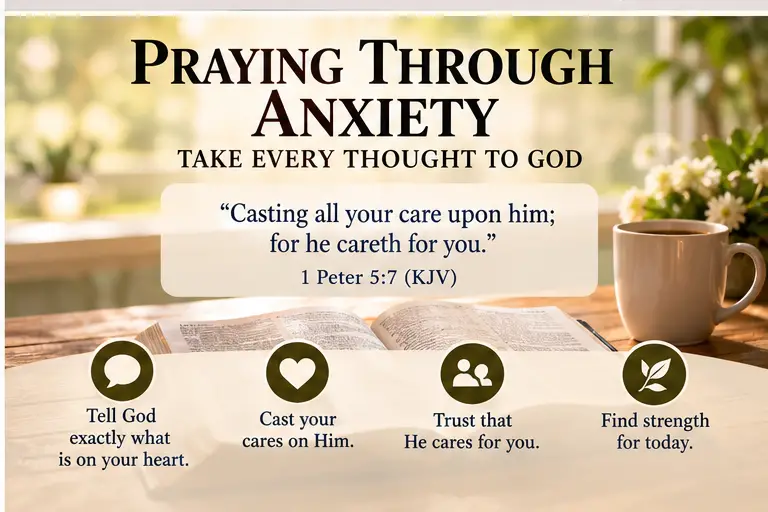
You do not need polished words to pray. These verses show that God welcomes honest, even desperate, cries, and some can become your own prayers.
- Psalm 139:23–24: Invite God into your anxious thoughts. “Search me, O God, and know my heart: try me, and know my thoughts: And see if there be any wicked way in me, and lead me in the way everlasting.”
What it means: The psalmist invites God to search the heart and lead in a faithful way.
Put it into practice: Pray honestly about what is weighing on your heart.
- Psalm 61:2: A prayer for an overwhelmed heart. “From the end of the earth will I cry unto thee, when my heart is overwhelmed: lead me to the rock that is higher than I.”
What it means: This cry from an overwhelmed heart shows that prayer can begin with distress rather than polished words.
Put it into practice: Use the verse as a short prayer when you cannot find your own words.
- Psalm 34:17: God hears and delivers. “The righteous cry, and the LORD heareth, and delivereth them out of all their troubles.”
What it means: The psalm celebrates God’s attention to the cries of the righteous.
Put it into practice: Tell God about your trouble and consider asking someone trustworthy for help.
- Psalm 34:18: God is near the brokenhearted. “The LORD is nigh unto them that are of a broken heart; and saveth such as be of a contrite spirit.”
What it means: God’s nearness is especially precious to those whose hearts are broken.
Put it into practice: Offer a compassionate word to someone hurting, including yourself.
- Psalm 18:6: Your cry reaches God’s ears. “In my distress I called upon the LORD, and cried unto my God: he heard my voice out of his temple, and my cry came before him, even into his ears.”
What it means: David remembers calling to God during distress and being heard.
Put it into practice: Describe your present difficulty plainly in prayer.
- Romans 8:26: When you have no words, the Spirit prays for you. “Likewise the Spirit also helpeth our infirmities: for we know not what we should pray for as we ought: but the Spirit itself maketh intercession for us with groanings which cannot be uttered.”
What it means: Paul teaches that the Spirit helps believers in weakness when prayer feels difficult.
Put it into practice: Sit quietly and pray simply, without pressuring yourself to find perfect words.
- Hebrews 4:16: Come boldly for help. “Let us therefore come boldly unto the throne of grace, that we may obtain mercy, and find grace to help in time of need.”
What it means: Because of Christ, believers may approach God confidently for mercy and timely help.
Put it into practice: Ask God for the specific help you need today.
- Jeremiah 33:3: God answers when you call. “Call unto me, and I will answer thee, and shew thee great and mighty things, which thou knowest not.”
What it means: God invites Jeremiah to call on him during confinement and uncertainty.
Put it into practice: Pray for wisdom while you seek sound guidance.
- Psalm 46:1: Help that is present right now. “God is our refuge and strength, a very present help in trouble.”
What it means: The psalm portrays God as a refuge and ready source of strength amid upheaval.
Put it into practice: Name one support person or resource you can turn to today.
- Romans 15:13: The God of hope fills you with peace. “Now the God of hope fill you with all joy and peace in believing, that ye may abound in hope, through the power of the Holy Ghost.”
What it means: Paul prays that hope, joy, and peace will abound through the Holy Ghost.
Put it into practice: Pray this blessing over yourself and a person who needs encouragement.
7 days of peace: a short reading plan for anxious hearts
Free printable devotional: Download your free 7 Days of Peace devotional (PDF). Follow seven days of KJV Scripture readings, reflections, practical actions, and prayers. No email address required.
Take one verse a day for the next seven days. Read it slowly in the morning, think about it during the day, and pray it back to God at night. Better yet, invite a friend to do it with you.
Day 1: Bring everything to God. Philippians 4:6 “Be careful for nothing; but in every thing by prayer and supplication with thanksgiving let your requests be made known unto God.” Reflect: Nothing is too small or too big to pray about. Make a list of what is worrying you and pray through it one item at a time. Pray: “Lord, here is everything on my heart. I give it to You.”
Day 2: You are cared for. 1 Peter 5:7 “Casting all your care upon him; for he careth for you.” Reflect: God does not just tolerate your worries. He cares about you. Pray: “Father, thank You that You care for me. Help me let go of what I keep picking back up.”
Day 3: Fix your mind on Him. Isaiah 26:3 “Thou wilt keep him in perfect peace, whose mind is stayed on thee: because he trusteth in thee.” Reflect: Each time your mind races today, gently turn it back to God. Pray: “Lord, keep my mind stayed on You, and keep me in Your peace.”
Day 4: You are not alone. Isaiah 41:10 “Fear thou not; for I am with thee: be not dismayed; for I am thy God:” (excerpt) Reflect: Whatever you face today, God is with you in it. Pray: “Lord, when I am afraid, remind me that You are with me and You are holding me up.”
Day 5: Just today. Matthew 6:34 “Take therefore no thought for the morrow: for the morrow shall take thought for the things of itself.” (excerpt) Reflect: You only have to live today. Leave tomorrow in God’s hands. Pray: “Lord, give me grace for today, and help me trust You with tomorrow.”
Day 6: Rest tonight. Psalm 4:8 “I will both lay me down in peace, and sleep: for thou, LORD, only makest me dwell in safety.” Reflect: Read this verse aloud before you turn out the light. Pray: “Lord, I lay down my worries with my head tonight. Watch over me while I sleep.”
Day 7: Receive His peace. John 14:27 “Peace I leave with you, my peace I give unto you: not as the world giveth, give I unto you. Let not your heart be troubled, neither let it be afraid.” Reflect: Look back over the week. Where has God met you? Pray: “Jesus, thank You for Your peace. Help me keep coming back to You.”
Finished the seven days? Share the plan with someone who needs it, and start again whenever anxiety returns.
Frequently asked questions about anxiety and the Bible
Is it a sin to feel anxious?
Feeling anxious is part of living in a broken world, and it is not something to be ashamed of. Jesus Himself was in agony in the garden of Gethsemane (Luke 22:44), and Paul wrote of the daily care he carried for the churches (2 Corinthians 11:28). The Bible’s answer to anxiety is not shame but an invitation: bring it to God in prayer (Philippians 4:6–7).
Does the King James Bible talk about anxiety?
Yes, though it uses older words. “Be careful for nothing” (Philippians 4:6) means “do not be anxious about anything.” “Take no thought” (Matthew 6:34) means “do not worry.” The KJV also speaks of “heaviness in the heart” (Proverbs 12:25) and a soul that is “disquieted” (Psalm 42:11).
What is the best Bible verse for anxiety?
Many Christians turn first to Philippians 4:6–7, because it gives both an instruction (pray about everything) and a promise (the peace of God will keep your heart and mind). For anxiety that comes from fear, Isaiah 41:10 is a powerful place to start.
Is it wrong for a Christian to see a doctor or counselor for anxiety?
No. Luke, who wrote two books of the New Testament, was a physician, and Paul called him “beloved” (Colossians 4:14). Prayer and Scripture are vital, and so is wise help from a doctor, counselor or pastor. Seeking help is not a lack of faith.
A prayer for an anxious heart
Lord, You know every thought that is racing through my mind right now. I bring You the things I am afraid of, the things I cannot fix, and the things I cannot stop thinking about. I cast all my care upon You, because You care for me. Quiet my mind. Steady my heart. Fill me with the peace that passes all understanding, and keep my heart and mind in Christ Jesus. In His name I pray, Amen.
If your anxiety feels like too much
You do not have to carry it alone. Talk with your doctor, your pastor, or a Christian counselor. If you are having thoughts of harming yourself, please reach out right now to your local emergency number or a crisis line. Asking for help is a step of faith, not a failure of it.
Know someone who is anxious today? Share this page with them. One verse at the right moment can bring real peace.
Which verse helps you most when anxiety rises? Share it in the comments below. Your answer may help someone else.
More peace from God’s Word
Continue with Bible verses about healing the mind, Bible verses about fear, and Bible verses for healing and comfort.
- 51 Bible Verses About Pain for when you are hurting
- [55 Bible Verses for Grief and Loss] for anyone mourning a loved one
- Bible verses for healing and comfort
About the Author

Ordained Christian Minister Since 1988
Pastor David Small has served in Christian ministry for 38 years, preaching, teaching, and encouraging believers to grow in their relationship with God. His experience includes pastoral leadership, evangelism, biblical teaching, and helping individuals and families navigate life’s challenges through faith and prayer.